

PASET-Rsif researchers advance renewable energy solutions in Africa
In many parts of Africa, unreliable power supply remains a daily reality, disrupting essential services and constraining businesses. But a new wave of scientists emerging from African universities is beginning to redefine access to clean and sustainable energy. Through the Partnership for Skills in Applied Sciences, Engineering and Technology (PASET) – Regional Scholarship and Innovation Fund (Rsif), managed by the International Centre of Insect Physiology and Ecology (icipe), these researchers are developing solutions with impact beyond the energy sector.
One area where this innovation is making a significant difference is in agriculture and food processing—sectors that depend heavily on reliable energy.
Solar-assisted heat pump dryer
Across sub-Saharan Africa, farmers suffer significant post-harvest losses, largely due to limited access to effective preservation technologies. According to the World Food Programme (WFP), between 30–50 per cent of grains and up to half of fruits and vegetables are lost annually, valued at over $4 billion. In Tanzania alone, the Food and Agriculture Organization (FAO) estimates that farmers lose up to 40 per cent of their annual harvests.
These losses are driven by inadequate storage, poor transport infrastructure, and high humidity, all of which exacerbate food insecurity and reduce farmer incomes. In many cases, farmers resort to drying produce in the open sun—an approach that exposes food to contamination, weather fluctuations, and uneven drying, ultimately lowering quality.
Researchers at the Nelson Mandela African Institution of Science and Technology (NM-AIST), one of PASET-Rsif’s African Host Universities (AHUs) in Tanzania, are working to change this. Supported by the fund, they have developed an innovative solar-assisted heat pump dryer designed to preserve agricultural produce more efficiently and reduce post-harvest losses.
The project, led by energy researcher Dr Thomas Kivevele alongside co-investigator Dr Janeth Marwa and international collaborators, harnesses Tanzania’s abundant solar radiation to dry fruits, vegetables, and other biomaterials. Unlike traditional solar dryers that rely solely on sunlight, the system integrates a heat pump and thermal energy storage, enabling it to operate even on cloudy days or at night.
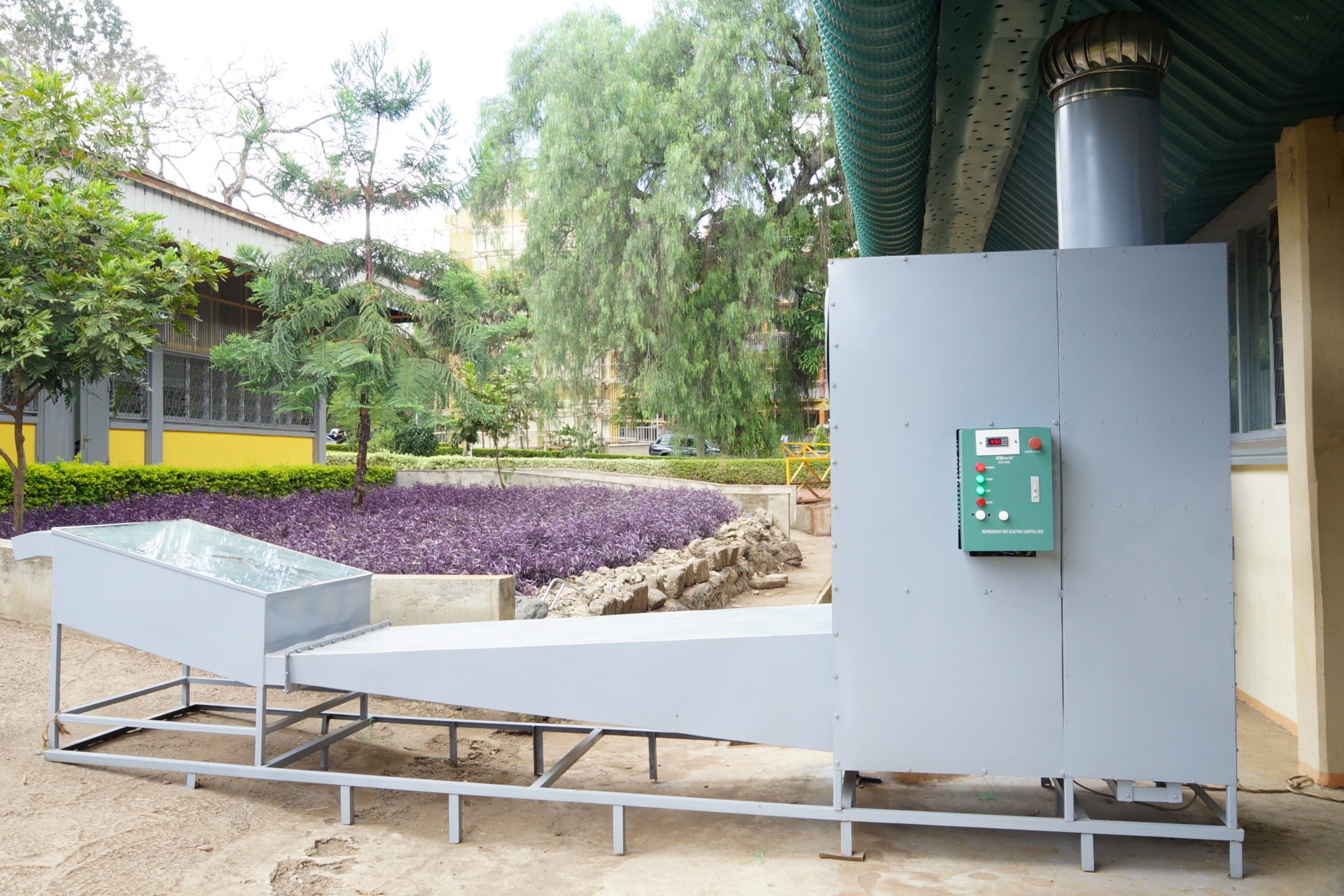
This innovation offers a reliable alternative to traditional drying methods that often fail to preserve product quality or nutritional value. By combining renewable energy with locally available materials, the technology improves the consistency and safety of dried products while reducing losses. More broadly, it demonstrates how African-led research can strengthen sustainable food systems and improve farmer incomes.
Such innovations are not isolated. Across the continent, PASET-Rsif scholars are applying science, engineering, and technology to address persistent energy and development challenges.
Research output in renewable energy
A recent synthesis review titled “A systematic and participatory assessment of the contribution of the Regional Scholarship and Innovation Fund (Rsif) research and innovation outputs in Renewable Energy thematic area to the Socio-economic Development Goals in sub-Saharan Africa” shows that research output in renewable energy has grown rapidly, with significant acceleration between 2023 and 2025.
By December 2025, scholars in the Energy and Renewables thematic area had produced 94 peer-reviewed journal articles, alongside conference papers, doctoral theses, and four major innovation grant projects across at least 10 countries, including Kenya, Nigeria, Burkina Faso, Cameroon, Tanzania, Mozambique, Ghana, and Côte d’Ivoire. These outputs reflect a shift toward practical, problem-solving research and stronger cross-border collaboration.
Bio-waste valorisation
Solar energy dominates much of this work, reflecting Africa’s vast but underutilised potential. At the University of Nairobi, for example, researchers are advancing perovskite solar cells by developing self-cleaning coatings designed to maintain efficiency in dusty and arid environments. This addresses one of the most persistent challenges facing solar installations—performance degradation due to dust accumulation.
Innovation is also extending beyond electricity generation. At the University of Port Harcourt in Nigeria, researchers are exploring bio-waste valorisation using red onion skin and orange mesocarp to develop eco-friendly chemical formulations. The project has already produced patents, Material Safety Data Sheets, and scholarly publications, demonstrating how agricultural waste can be transformed into valuable industrial inputs.
Other initiatives are tackling biogas production, improved cookstoves, and thermal energy management systems—contributing to cleaner cooking solutions and more efficient industrial processes.
Together, these efforts point to a broader shift: energy innovation in Africa is increasingly being approached as part of a circular economy, where solutions are designed not only to generate power but also to address interconnected challenges in agriculture, industry, and environmental sustainability.